WHAT ARE TUBULAR BREASTS?
Posted On: January 09, 2019 Author: The Office of Dr. Stuart Linder Posted In: Breast Implants, Breast Reconstruction, Breast topics, Plastic Surgery, Tuberous Breasts, Tubular Breast
Tubular breast deformities are not all that uncommon. By definition, it is associated with herniation of breast tissue into the nipple areolar complex, constriction along the lower pole of the breast causing a poorly defined inframammary fold. Often the nipple areolar complexes are also lowered causing some degree of sagginess or ptosis.
Repair of the tubular breast can be performed by placing saline or silicone breast implants either through the subglandular or under the muscle with a dual plane technique. In the past implants were usually placed above the muscle in the subglandular pocket. However, presently Dr. Linder places the implant most commonly in the dual plane, two-thirds under and one-third over the muscle, depending upon the degree of the tubular breast deformity. If there is a very thick amount of glandular tissue subglandular retromammary placement may be preferable in order to allow some upper pole fullness along the medial sternal area (towards the middle of the chest cleavage area). If, however, the tubular breast is associated with minimal amounts of breast tissue, then Dr. Linder places the implants usually under the muscle medially in order to reduce visibility palpability of the implant edge.
RECONSTRUCTION OF TUBULAR BREASTS
Reconstruction of a tubular breast includes breast augmentation with saline or silicone implants, releasing the inframammary fold, the crease line underneath the breast, to a proper position and scoring of the lower pole of the breast in order to evaginate it outward, allowing it to become more rounded in shape. If there is a significant degree of sagginess, then a breast lift may also be required with a reduction of the size of the areolar.
Postoperatively, a tubular breast should be treated with an upper pole compression band which will allow relaxation of the upper portion of the breast, allow the implant to be inferiorly displaced and allow for the lower pole of the breast to become more rounded and less flattened in shape. The bands can sometimes be worn up to six to eight weeks, depending upon the length and time it takes to lower the implant to regain a normal rounded shape. Tubular breast deformity reconstruction is a challenging operation, but in the hands of a board-certified plastic surgeon, can be a wonderful operation with a very satisfied patient.
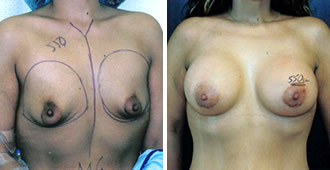
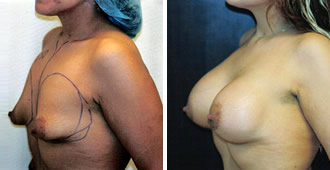
Case Study #1
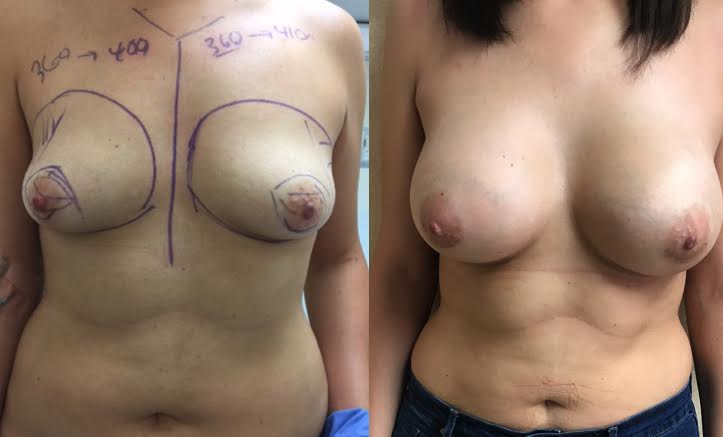 I was presented with a female patient who requested breast augmentation surgery along with correcting what she called her “constricted breast.” During her examination, I found that she had a condition called tubular breast deformity. Tuberous breasts or tubular breasts are a result of a congenital abnormality. After listening to her goals, we agreed to her expectation and scheduled her surgery date.
Case Study #2
This past summer, I was presented with a patient who was looking to improve the shape of her breasts. During the examination, it was apparent that she had a condition caused by her breast tissue not developing properly during puberty. The condition is called tuberous breasts, and as you can see by the pre-op photo, she is experiencing this abnormality in both breasts. The close-up photo also shows the elongated shape and protruding nipple with a slightly larger areola. After listening to her expectations, we agreed to perform a primary augmentation and schedule a surgery date.
During the tuberous breast correction, I released the tissue in the lower pole and placed moderate saline implants using 380 cc on the left and 390 cc on the right breast.
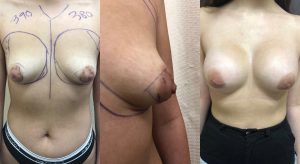 The post-op photo shows the patient after five months, and as you can see, she has a nice full shape and enhanced cleavage. She is very happy with her fullness and outcome.
Below is an example of marking a patient prior to this type of correction surgery (the video is not of the patient mentioned above).
To schedule your consultation with Dr. Linder or learn more about breast augmentation surgery, call our office at 310-275-4513 or fill out our online contact form today.